ProbabilityV0
Description
Reinforcement learning environment for training parameterized quantum circuits to approximate a target probability distribution over computational basis states. It is based on the QuantumEnv base class.
The goal of ProbabilityV0 is to optimize variational quantum circuits such that the measured probability distribution of outcomes matches a given target distribution. This is useful in tasks like quantum compilation, quantum generative modeling, and distribution learning.
Environment Dynamics
State (observation): The current probability distribution over
2**n_qubitsbasis states obtained from the quantum circuit.Action: A continuous vector of parameter updates (
Box(low=-0.1, high=0.1, shape=(n_params,)), which perturbs the trainable parameters of the ansatz.Reward: Defined as the negative of a weighted cost combining:
KL divergence between the target distribution and the circuit’s output.
L2 distance between the target and circuit distributions. The weighting is controlled by
alpha(for KL vs. L2) andbeta(step penalty).
Episode Termination:
If the reward is below the specified tolerance.
If the number of steps reaches
max_steps.
Key Parameters
n_qubits (int): Number of qubits in the circuit.target_distribution (np.ndarray): Target probability distribution (must sum to 1).ansatz (callable, optional): Custom circuit ansatz. Defaults to a simple layer of RY rotations if not provided.max_steps (int, default=100): Maximum steps per episode.tolerance (float, default=-1e3): Reward threshold for termination.alpha (float, default=0.5): Weight between KL divergence and L2 error.beta (float, default=0.01): Penalty weight for step count.ffmpeg (bool, default=False): IfTrue, uses FFmpeg for saving animations; otherwise uses Pillow (GIF).
Visualization
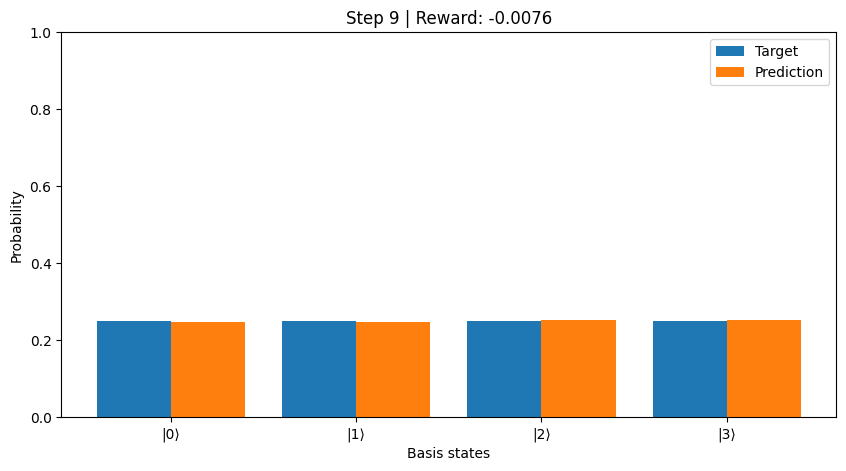
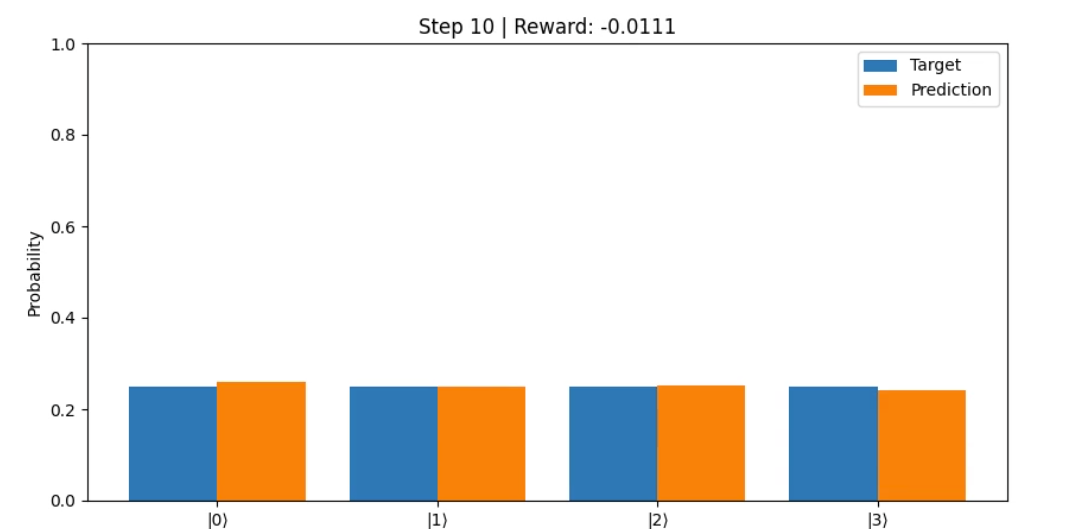
render(): Creates an animation showing the evolution of the learned distribution and corresponding rewards across training.
Applications
Distribution learning with quantum circuits.
Testing expressivity of variational ansätze.
Benchmarking optimization of quantum neural networks.
[2]:
from pennylane import numpy as np
import pennylane as qml
from qrl.env import ProbabilityV0

n_qubits = 2
target_distribution = np.array([0.25, 0.25, 0.25, 0.25])  # Example target distribution

# initialize environment
# set ffmpeg=True if you have ffmpeg installed to save as mp4, or ffmpeg=False to save as gif
env = ProbabilityV0(
    n_qubits=n_qubits,
    target_distribution=target_distribution,
    alpha=0.7,   # KL vs L2 weight
    beta=0.01,   # step penalty
    max_steps=10,
    ffmpeg=False
)

# Reset environment
params, _ = env.reset()


# Use PennyLane's optimizer
opt = qml.GradientDescentOptimizer(stepsize=0.2)

# params = env.params.copy()
for step in range(env.max_steps):
    params, cost_val = opt.step_and_cost(env.get_reward, params)
    probs = env.circuit(params)

    # Save history for rendering
    env.history.append(probs)
    env.params = params  # update env params
    reward = -cost_val
    env.rewards.append(-cost_val)
    print(f"Step {step}: Reward = {reward:.4f}")

    if reward > -1e-2:  # close to perfect
        break

# Animate the full evolution
env.render(save_path_without_extension='probabilityV0')
Step 0: Reward = -1.3208
Step 1: Reward = -0.2667
Step 2: Reward = -0.1845
Step 3: Reward = -0.1294
Step 4: Reward = -0.0906
Step 5: Reward = -0.0626
Step 6: Reward = -0.0421
Step 7: Reward = -0.0270
Step 8: Reward = -0.0158
Step 9: Reward = -0.0076